Panel Showdown: OLED vs IPS
The desktop monitor market is currently experiencing a technological schism. For years, In-Plane Switching (IPS) technology reigned supreme as the gold standard for color accuracy and viewing angles. Recently, Organic Light-Emitting Diode (OLED) technology has migrated from televisions and smartphones to the desktop, promising unparalleled contrast and motion clarity. Choosing between the two requires a clear understanding of their respective structural mechanics and inherent trade-offs.
The Mechanics of IPS (In-Plane Switching)
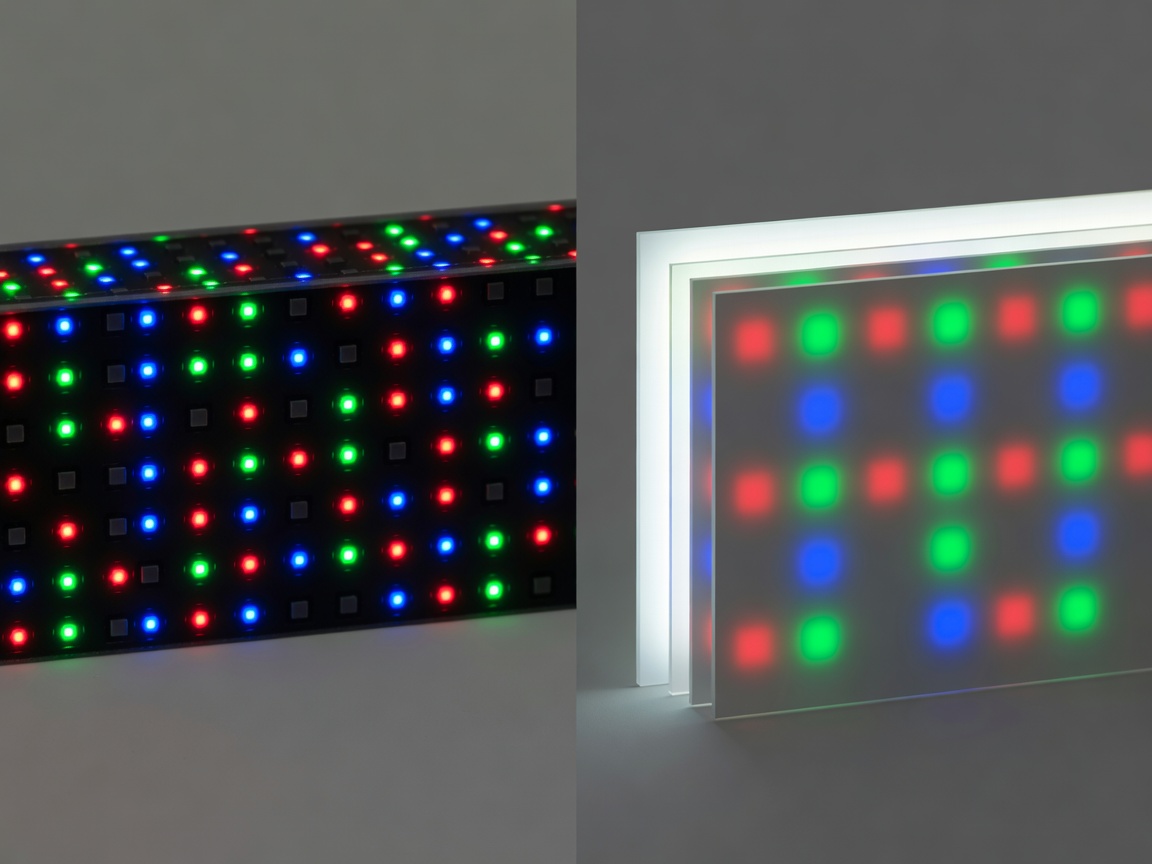
IPS panels operate on a transmissive basis. They utilize a constant, global backlight (typically an LED array) situated behind a layer of liquid crystals. When a charge is applied, the crystals rotate "in-plane," acting as shutters that allow specific amounts of colored light to pass through.
Because the backlight is always on, an IPS panel struggles to display true black. When asked to show black, the liquid crystals attempt to shut completely, but a small amount of light inevitably bleeds through. This results in the dark grey appearance common to IPS screens in dark rooms, often yielding contrast ratios of roughly 1,000:1. However, IPS monitors excel at sustained, high overall brightness and possess zero risk of permanent image retention, making them workhorses for productivity and design.
The OLED Advantage: Emissive Pixels
OLED panels discard the backlight entirely. Instead, each individual pixel contains organic compounds that emit their own light when subjected to an electrical current. If a scene requires a pixel to be black, the monitor simply removes the charge from that specific pixel, turning it completely off.
This emissive nature grants OLED monitors a theoretically infinite contrast ratio. A lit star can sit perfectly adjacent to pitch-black space with zero light bloom or haloing. Furthermore, because there are no physical crystals twisting, pixel response times on OLEDs are near-instantaneous (often below 0.1ms), resulting in pristine motion clarity that outpaces even the fastest IPS displays.
The Burn-In Concern
The defining weakness of OLED is organic degradation. If static elements—such as a Windows taskbar, application menus, or a game's HUD—are displayed at high brightness for thousands of hours, the organic compounds in those specific pixels degrade faster than the surrounding areas. This causes a permanent shadow of the static element to remain on the screen, a phenomenon known as "burn-in."
Manufacturers employ mitigation strategies like pixel shifting, logo dimming, and compensation cycles run during standby modes. While modern OLEDs are far more resilient than early iterations, the fundamental chemistry remains. Users executing 40-hour work weeks utilizing static spreadsheets are accepting an inherent risk when selecting OLED.
Brightness Constraints and ABL
To further protect the panel and manage power draw, OLED monitors utilize Automatic Brightness Limiter (ABL) algorithms. If a scene requires the entire screen to be white (like a maximized web browser), the monitor aggressively dims the entire panel. In contrast, an IPS panel can sustain 100% full-field white brightness indefinitely.
Conclusion
The choice is entirely dictated by use-case. For competitive gamers and cinema enthusiasts who consume dynamic, moving content in dim environments, the infinite contrast and instant response times of OLED are unmatched. However, for office workers, graphic designers, and coders operating in bright rooms with static interfaces, the sustained brightness and durability of an IPS panel remains the logical, reliable choice.